
How to Fit a Dog Harness
To fit a harness on a dog properly, there are a few key points to remember. Not every harness is suitable for every dog. Harnesses come in a vast range of designs and various adjustment methods. Your dog’s harness should be snug but not too tight. It should sit comfortably so it doesn’t impede your dog’s movement in any way. And it shouldn’t ride up into your dog’s armpits or neck.
This is why we offer a harness fitting service at our pet shop for free (call to book or just pop in). We want to make sure your dog is super comfortable and happy after all!
Types of Dog Harnesses
There are a huge range of harnesses in different styles available now. If you pop into Pet Stop, you’ll see we have an entire wall decorated with harnesses in every style, colour and pattern imaginable.
Step In Harness
Step-in harnesses are often made of soft material and have Velcro strapping. These are best for small to medium dogs and puppies and are usually the ones that feature the largest range of patterns and colours. Not generally recommended for larger, more powerful dogs. You also need to check that the design doesn’t impede the dog in any way, as the only adjustment on these harnesses is around the chest.

Front and Back Clip Harness
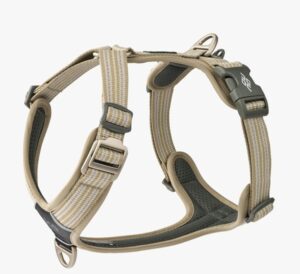
These are usually fully adjustable around both the head and chest and vary in design between those that go over the head or feet first. The optional addition of a front clip allows you to have more control over your dog by using a double-ended lead. Having the additional front clip on mans you can guide them while remaining more in control.
These harnesses vary in design, ranging from those with padded straps to those with handles for added safety and control.
Fitting a dog harness step by step at home
Step One – Your dog’s measurements
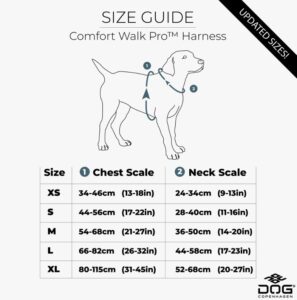
Once you’ve decided on a style of harness for your dog, you’ll want to take some key measurements so you can choose the right size. All manufacturers provide a size guide to help you easily choose the right fit. As you’re fitting from home, you won’t have the luxury of trying on lots of different harnesses, so you’ll want to try and get the right size first time!
Neck – take a measurement around their neck nearest to their shoulders.
Chest – measure their chest, behind their front legs and up around their back.
Weight – take their weight measurement. It’s not always needed, but some manufacturers look at the weight of the dog or the breed as a size guide.
Here’s the example taken from Dog Copenhagen Website
Step Two – Fitting the dog harness
Now that you’ve ordered the correct harness for your dog, loosen all the straps so you can easily put it on them.
If your dog is particularly anxious, use treats at each step to reward them and give them lots of praise.
Dogs that are extremely sensitive to touch (for example, you know they are likely to snap at you if you attempt to put something over their head) may need to take part in some additional training before you try to put a harness on them. Please don’t force them and seek the guidance of a professional dog trainer first.
Next, tighten up the straps one by one to ensure they are snug but not too tight. You should be able to fit two fingers between your dog and the harness at any point.
Once adjusted, you shouldn’t need to re-adjust, simply unbuckle the harness and it’s ready to go anytime you need it.
Things to check:
- Your dog is able to move freely and without chaffing on the harness. If this happens, you may need a slightly different design – all dogs are shaped differently, and some designs are more suitable to one breed than another.
- Your dog refuses to walk – is it because this is something new for them? In which case, spend some time in the house playing games while they’re wearing their harness to give them time to get used to it. Watch them closely for signs of discomfort and re-check for signs of chaffing/restriction on movement.
- Your dog wiggles free – every owner’s worst nightmare! Some dogs are like Houdini and figure out a way to escape their harness while on a lead, usually by walking backwards out of it. Although a properly fitted harness is harder to escape from, we would always recommend adding a halti link for some extra security. Visit our store and we’ll help you choose the right harness and fit for your dog’s specific needs.
When fitting at home, we’d recommend leaving the tags on until it’s fitted and you’re happy it’s right for your dog. Most good pet shops will allow returns on harnesses that are returned unused and with labels intact.
Harness Myths
One of the biggest myths we hear is that harnesses encourage pulling on lead. There is no evidence to support this claim. Harnesses provide more safety and control around your dog, relieving stress on their neck.
Dogs don’t pull because they’re in a harness, dogs pull because they walk faster than humans! They pull because the outside world is full of incredible smells, interesting people to meet, and dogs to greet.
The best way to reduce pulling is through training.
A front clip harness can help with this, as you have more control over the speed at which your dog goes from both the front and the back.
It’s not easy for dogs to learn to slow down, to go at our pace, and ignore all the incredible and exciting distractions. It’s no coincidence that pulling on the lead is one of the most common dog training struggles.
There is also a thing called ‘natural opposition reflex’, which is where a dog will naturally pull against pressure. This reflex happens with both the harness and a collar. But what we can say for sure is that harness or no harness – if a dog wants to pull, they’ll pull. A harness is just a much more comfortable way to do it than on a collar.
If you’d like to book in for a harness fitting, you can do so by giving us a quick call at the shop or just pop in. We can try different styles depending on your and your dog’s preferences.
Anxious dog? No problem – we’re happy to stay open later so there are no other little visitors in store to worry your dog and give them the VIP experience!
